Friday, 2 December 2011

How to Be a Rogue Trader

Fresh in the minds of the public is 31 year-old Kweku Abodoli, the rogue trader who lost Swiss bank UBS over $2 billion in unauthorized trades in Exchange Traded Funds (ETFs). The magnitude of the losses and scandal of the fraud and secrecy excited news agencies worldwide. It was by-and-large portrayed as a freak event. However, according to Financial Times columnist John Gapper's new book How to Be a Rogue Trader, rogue traders are actually features of the system

The book argues that rogue traders are systemic for two main reasons: 
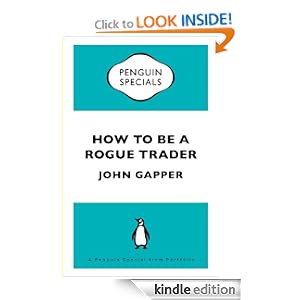
How To Be a Rogue Trader: An eSpecial from Portfolio / Penguin
(Amazon.com)

  • Banks are willing to take the risk that these people exist in the organisation. If they fret too much over losses, they will never be able to make meaningful profits. 


  • Rogue Trading is inherent in human psychology. In order to avoid losses, people will often take on massive risks by doubling down. The outcome is usually, well, sub-optimal. 


The major cases of rogue trading have been Joseph Jett at Kidder, Peabody in the 1980s, Nicholas Leeson at Barings in the 1990s and Jerome Kerviel at Societe General in 2008. But how many Leesons and Kerviels have there really been? If rogue traders are as ubiquitous as Gapper writes, it only stands to reason that every bank has had their fair share. Likely, the banks keep instances of rogue trading quiet to keep their reputations intact. 

Nick Leeson - The type of person the banks employ.
The type most likely to be a rouge trader!

(themarketoracle.blogspot.com)

What are the characteristics of the common rogue trader?

Gapper notes that rogue traders are typically 'outsiders.' They went to the second-tier schools, they worked in the back office, they are trying to make their mark. They also tend to be charismatic, so that they can charm or bully their way out of proper oversight. 

What can be gleaned from this analysis? The very personality type banks look for: money-hungry, charismatic young men, are exactly the type of person most likely to be the rouge traders. Banks need to review their psycho-analysis tests and start hiring more conservative personalities. And please, try hiring some women. 

Tuesday, 29 November 2011

The High-Frequency Boys


(bloggingstocks.com)
Have you ever played Poker? Sometimes you win; sometimes you lose. The whole time you are wondering what cards the other players are holding. 'Does he have a King. If not, I will WIN!' (Too bad, he had the King!) As I have outlined in previous posts, the markets, or, trading them at least, is like gambling, because you never know the 'hand' that the market is getting ready to play. You take your position and see if you can win the game. Yet there is another game being played in Wall Street and the City these days... Some people are playing Poker whilst looking right at everyone else's cards!

It's called High-Frequency Trading (HFT). HFT is done with light-speed computers trading anything from shares to commodities literally thousands of times a day, making many small but consistent profits per trade, often just one penny per share! This is done by buying and selling these instruments over a period of mere seconds - or even fraction of a second!
                                                                    (AlgoTechnologies)

How are these trades so consistent? How could a computer possibly know the direction a stock will move in one second?! The answer is, by this point obvious: The computers cheat. They see the Order Book and know the coming Bids and Asks*. Simple computer programmes are written to buy and sell these stocks based on future bids and asks being met by exchanges.This is known as Front Running, essentially having insider information and profiting from it.

Another strategy used by HFT is known as Quote Stuffing. This is when the HFT computers place a large number of orders to influence the price of a financial asset and then immediately cancel them. This allows them to minipulate the market and profit from the future price change.

How do these strategies perform?

(http://hft-capital.com/)
Quite well actually! The returns seen in the chart to the left look larger-than-life, too good to be true. Normally, they would be too good to be true, but when you can read the Order Book...

Basically, HFT is a license to mint money. It is currently legal but is under increasing scrutiny from the press and the public. While many people in the industry see HFT as corrupt and manipulative, most hold their nose.

Why? Liquidity. Because HFT relies on thousands of trades per day, these traders make life easier for other traders. When trading common shares, you can rest assured that your bids will be hit almost instantaneously thanks to HFT.


What's my take? Let 'em stay. But I want to see more regulations. Don't let HFT place false bids or manipulate the market. Only quantitative strategies should be acceptable.

*A Bid is the price a buyer is willing to buy at. An Ask is the price a seller is willing to sell at.

Saturday, 19 November 2011

Uncle Sam Get's Rich off the Nonchalant

Raj Rajaratman -
11 years in Prison for Insider Trading

(worldsetrends.blogspot.com)

US Congress - Infinite years
 of Re-election regardless of Insider Trading

(euobserver.com)

Recently, it has been released that over 70 members of the House of Representatives and the Senate - including top members of Congress, like House Minority Leader Nancy Pelosi of California and House Speaker John Boehner of Ohio - have been profiting handsomely off of insider information. And they've done it all legally!

What's going on is that when takeover bids occur in the United States, they have to send the government certain documents for approval. This is because of governmental anti-trust laws in place to prevent collusion and monopoly within various industries. Members of Congress are privy to this information and, unfortunately, profit from it!

This info was released on CBS’s programme 60 Minutes and has caused a deeply resentful public to become further alienated to their representatives.

(postamericana.word)
If you or me did this, we would be in jail like Raj, but not if we were in the government! Why, because the government writes the laws! If the Congress decides to slip in a law under the people's noses that lets them do inside deals and basically free money, they can! What infuriates me is not so much that Uncle Sam is so unbelievably corrupt - everyone knows that - but that the American people are not more upset by this.

Why aren't the Occupy Wall Street hippies occupying Washington D.C.? Why isn't there a forced government shutdown and massive inquiry into Congress? Why isn't the law changed overnight? Why are do these people have a 15% approval rating but an 80% re-election rate?


(www.rickperry.org) 

Because Americans are stoooopid, politically at least. Regardless of how corrupt the system is, each side will support their respective parties. If you ask an Obama supporter why they voted for him: 'Oh I didn't like Bush's wars.' (Still in 'em, buddy!). Ask a Republican why they don't like Obama: 'Look at all that debt!' (uh... did you see Doubya's debt?!). Because party loyalists defend there respective sides, real solutions are never developed and corruption persists. I hope the next generation is wiser.


Tuesday, 15 November 2011

It's the Free Market!


Looking around at all the problems in the world: the Euro, China raping Africa, US debt, IMF shark loans to third-world nations, I think to myself: Where is the justice in this world? Why don’t our Democracies and Republics truly represent the people? Why do we have massive debt AND high taxes? Where did all the inflation come from? Why does the government have to see my genitals when I go through the airport? Are they that dangerous?

(bbc.co.uk)


The answer comes from the movie Wall Street. No not the recent one with the awkward love story, the 1980s Wall Street that convinced everyone that greed was good and inspired everyone to go out and join the Goldman Sachs of the world. Gordon Gekko explains thusly:


“The richest 1% of this country owns half this country’s wealth, $5 Trillion. Now you’re not naive enough to think we’re living in a Democracy, are you Bud? It’s the Free Market!”


                                                                    (Wall Street - 1987)


Think about it. Why does Germany have more power than Greece? Sheer size and scope are part of it, but the main reason is that bond traders deem German debt less risky than Greek debt. The Free Market has chosen its winner and given more power to Germany in terms of lower price-of-borrowing and credit rating.
Why does the USA have awful debt and yet can afford to bailout Europe and print money without much cause for alarm? Because the Free Market has given the USA a free pass. It has an almost flawless credit rating and can borrow at dirt cheap rates from the market.

This explains national influence, but go a step further. Why is it that middle-class and poor immigrants must often wait years to gain admission into Western nations, but high-net-worth individuals come in without much notice? Because nations are clubs. If you’ve got the dosh, you’re in.

(thoughts-and-stuff-zwright.blogspot.com)
Why is it that central banks – the Federal Reserve, the Bank of England, the ECB, etc. are completely independent of the governments and people they supposedly help? (By the way, the Federal Reserve was only called Federal so that they could trick the population to thinking, go figure, it was actually federal!) Because they are part of the real government – the Free Market!


As noted by Robert Preston in his BBC blog, the Federal Reserve unilaterally decided to bailout the Eurozone. The wealth of America’s citizens is stolen to pay for the lazy Greeks – and they have absolutely no say! All because of the power of central banks. Of course Preston said the action was fantastic. He’s part of the establishment.

War, famine, upheaval, the price of a paperclip… It’s the Free Market!

Tuesday, 8 November 2011

Why the EU will Federalise


The European Union is an abject failure. European nations were supposed to come closer together and learn to live in harmony with one another. Trade was supposed to boom and economies would grow to rival the United States and China. Political influence was supposed to be unmatched. Super money, super diplomacy, Superpower, super ludicrous.

(dreamstime.com)
European nations are further apart now than in decades. The lazy, un-innovative, spend-happy Greeks hate the controlling, wealthy Germans. The Italians feel the loss of their historic pride as their borrowing costs soar. The Germans are tired of bailing out the Club-Med nations as their own debt starts to grow out of control.

Besides an utter lack of European ‘harmony,’ the EU has done little to improve the economy of Europe, with the obvious exception of Germany. Unemployment has remained high, growth stagnant and most innovation is pushed by the state. Many have started to call the EU the U.S.E.R. the United Socialist European Republics.

(realtruth.org)
As for the idea that a united Europe would form one of the world’s three super powers along with the US and China, give me a break! The US and China have had to recently negotiate with European leaders about keeping the Eurozone alive!

Some unions work. The United States (yes that means united countries) and United Kingdom are examples where unions can function well. But these unions were able to work because the nations that joined together had similar cultures and ethics. Trying to take cultures as far apart as Germany and Greece and shoving them together is asking for trouble.

Many people now realise that the political and monetary union has failed, mostly because the hard-working north cannot pay for the south forever. So the logical conclusion would be: dump the Euro, go back to Drachmas, D-Marks and Francs. Keep the European Free Trade Zone and immigration policies to keep the ‘European’ idea going if you must, but salvage what is left of the European economy before China and the IMF buy it all!
(financialpost.com)

This will not occur. France and Germany control Europe and are some of the only countries in the union for which the Euro is beneficial. The answer to the uncontrollable debt will be complete forgiveness of Greek, Italian and Spanish debts, along with certain austerity measures. The debts of these nations – and the nations themselves – will be federalised into the United States of Europe. Eurobonds will be created so that investors can have a little bit of German debt in the bonds even though they will be exposed to Greek and Spanish debt.

The United States of Europe will be sold as the ‘Only Solution.’ Honestly, we didn’t want to federalise, but we had to! Otherwise the whole world’s financial system would collapse! I’ve heard it before and I’m sure I’ll hear it again. They create the problem so that they can offer the solution. 

Thursday, 3 November 2011

Green! No, Blue! (Ahhhhhhhhhhhh!!!!!)

In Monty Python and the Holy Grail, the hardest test for one knight was "What is your favourite colour?" His reponse: "Green, no, Blue!" got him thrown off the bridge.

Monty Python and the Holy Grail
(bobisdysautonomia.blogspot.com)
Financial speculators are often accused of doing the same thing as the fallen knight: guessing red or black in the proverbial Roulette Wheel of the market, with red being down (short-selling) and black being up (buying).

The latest 'knight' to fall off the bridge was Jon Corzine. Former Co-CEO of the notorious Goldman Sachs, Corzine went on to become Senator and Governor of New York. After being defeated in the latest election, Corzine went back to the fund-management world, becoming CEO of MF Global, a major hedge fund with Assets under Management (AUM) of over $10 Billion.

In his quest to regain his honour, according to John Gapper of the Financial Times, Corzine bet most of the firm's money (and then some!) on European debt, buying risky Spanish and Italian bonds. When these bonds turned sour, MF Global faced losses greater than $6.4 Billion! 1,066 employees were suddenly let go and commodities markets were disrupted.
Corzine, right, as Governor
(nytimes.com)
Effectively, our tragic knight guessed the wrong colour and failed to find his Holy Grail. Had he guessed 'Red' and bet against Spanish and Italian bonds, he would have made MF Global one of the biggest, baddest hedge funds in the world, cementing himself in history as a legend of success. Instead, he, and the fund, and everyone who worked their, are ruined.


The moral of this tale: If you play with fire, you will get burnt. If you gamble with the market, you will, eventually , lose. It doesn't matter if you were head of Goldman, a Senator and a Governor... The market is a noble woman: treat her with respect and you will be rewarded. Treat her as a game and you're sleeping on the couch!


Friday, 14 October 2011

Fibonacci or Why 1.618 is GREAT!

My last post introduced two hidden laws of the markets: the zero-sum game and the boom-bust proportionality cycle of 18 years. It even offered a striking prediction: economic stagnation until 2017!!

As promised here is a new law: Fibonacci.

What is Fibonacci? By the end of this post, you will be thinking 'What isn't Fibonacci?!,' but here we go:

This ear is ideal, because it follows a
 Fibonacci Spiral (Theabodeofpeace.com)
Discovered by Leonardo of Pisa (known then as Fibonacci), the mathematical sequence involves starting with 1 and then adding the 2 preceding numbers:

(0),1,1,2,3,5,8,13,21,34,55,89,144, etc.

This sequence gradually forms the ratio: Last #/Pentultimate # = 1.618. (144/89) = 1.6179.

Mona Lisa - Ideally 'Fibbed'
(wikispaces.com Fibonacci+Sequence)
In Dan Brown's wildly popular novel The Da Vinci Code, this ratio was referred to as The Golden Ratio and even the Divine Proportion. Why all the fuss?

The number 1.618 is so important it has been given the Greek letter ɸ (phi) in mathematics. ɸ permeates through our world: from the design of the body to that of Notre Dame to the very shape of our galaxy. Look closely at your finger. Notice how the distance between each joint seems to be proportionally larger than the last. If you care to measure, you will find that your finger follows a fibonacci sequence. The distance from the tip of your finger to the first knuckle is roughly 2cm. Going further, the distance from the first knuckle to the next is 3cm. From there to the third knuckle is 5cm! From there till the wrist is roughly 8cm. 2,3,5,8.... Fibonacci!

Yes, you're a formula - get over it!
(hy-se-sy-se.com)


Yet this goes further! The distance between the finger tip and the wrist and the wrist to the elbow forms a ratio of 1/1.618! Similar relationships exist between:


  • Length and width of face
  • Distance between the lips and eyebrows and length of nose
  • Length of mouth and width of nose
  • Distance between shoulder line and top of head and head length!


Beyond the Body, Fibonacci permeates throughout Nature:


Fib Flower: First layer of petals - 8; Second layer - 5
Reverse Fib Sequence
(jwilson.coe.uga.edu)

The Common Plant: Grows with the Fib
(jwilson.coe.uga.edu)


As can be seen, price seemed to move within defined proportions. Some traders are religious about 'Fib' trading, but in my humble opinion, a lot of it is hindsight. If you look at the following S&P500 chart showing the price movement of US shares during the 'credit crunch,' you can see that, indeed the price moved exactly to the 61.8% reversal point, a key figure watched by fib traders. However, hindsight is 20/20. Traders watch other Fib levels, such as the 38.2% level and the 161.8% level. Which one traders should use is hard to tell.


But how can we use this insight to our advantage financially? Financial technicians - traders who use mathematical formulae to make decisions - have discovered that this pervasive ratio can be used to forecast the price movements of various financial instruments. The idea is to measure a major movement - for example the the decline in the S&P500 during 2007-2008 - and then multiply the result by fibonacci ratios. The resulting numbers will be the most likely ends of the next price movement. The following video shows a trader explaining this phenomenon:

(LeverageFX.com) 


Indeed, Fib traders often include the 50% level into their screens, which isn't part of Fibonacci at all! However, it is psychologically important. Again using the S&P500, this time showing the market recovering from the 3-year slump from 2000-2003, we can see that it rises exactly 50% of the distance that it had just fallen!


fibonacci retracements act as support and resistance


 If you can take anything away from this post, I hope that you have learnt to see the world in a different way, 1.618 to be exact! The universe seems to move in a defined pattern, with humans, plants even the galaxy itself reliant on the Golden Mean!

Till next time, when I discuss why the US government thinks you're SCUM (and why their probably right!)